
Last updated July 10, 2026
The Complete Guide to Garage Door in New York City
Here’s a number that surprises most homeowners: roughly 60% of garage door service calls we handle in New York City stem from problems caused by the building itself, not the door. Pre-war carriage houses with 7-foot ceiling clearances. Mixed-use buildings where the garage sits below street grade. Co-op boards that demand specific aesthetic matches for brownstone facades. If you’re searching for guidance on garage door repair in New York City, most online resources won’t help you—they’re written for suburban ranch homes with 16-foot openings and unlimited headroom. In this guide, we’ll walk through what actually matters for NYC’s unique building stock: how to choose doors and openers that fit physically constrained spaces, navigate co-op and DOB requirements, evaluate security for street-level garages, and find a contractor who understands why your Gramercy Park carriage house isn’t a McMansion in Westchester.
Quick Answer
Garage door service in New York City requires specialized knowledge of pre-war building constraints, co-op board approvals, and low-headroom track configurations that suburban contractors rarely encounter. Homeowners should prioritize contractors with documented NYC experience, factory training on major brands like LiftMaster and Wayne Dalton, and familiarity with Department of Buildings permit requirements for structural modifications. For most NYC properties, a torsion spring system with a compact jackshaft opener offers the best balance of clearance, security, and long-term reliability.
Table of Contents
- How NYC Building Stock Dictates Your Garage Door Options
- Co-op Boards, Building Management, and DOB Permits
- Why Headroom Configurations Break Standard Rules
- Security Considerations for Street-Level Urban Garages
- How to Evaluate a Contractor’s Actual NYC Experience
- Brand and Opener Selection for City Properties
- Maintenance in New York City’s Climate and Salt Exposure
- When to Repair vs. Replace in NYC Buildings
How NYC Building Stock Dictates Your Garage Door Options
Walk into any garage in New York City and you’ll notice something immediately: these spaces weren’t designed for modern garage doors. The carriage houses of Gramercy Park and the West Village date to the 1880s, built for horse-drawn vehicles with wooden doors that swung outward. Mixed-use buildings from the 1920s and 30s often tucked garages beneath sidewalk level, creating moisture problems that suburban guides never address. Even post-war co-ops in Brooklyn Heights and the Upper East Side frequently sacrificed garage ceiling height to maximize residential square footage above.
These constraints create three categories of door challenges we see constantly:
- Pre-war carriage houses (Gramercy Park, West Village, Brooklyn Heights): Original openings often measure 7 feet or less in height, with stone or brick surrounds that can’t be modified without structural engineering. Standard 8-foot sectional doors won’t fit without custom ordering.
- Mixed-use and commercial-residential buildings (Lower East Side, Harlem, parts of Queens): Garages sit below grade with limited ventilation, accelerating rust on torsion springs and hardware. We’ve replaced springs in Long Island City buildings that failed in 4 years due to constant moisture exposure.
- Post-war co-op garages (Upper East Side, Forest Hills, Riverdale): Ceiling heights of 8-9 feet sound adequate until you account for ductwork, sprinkler lines, and structural beams that drop effective headroom to 6 feet or less.
In our 8 years serving New York City, we’ve learned that “standard” is a dangerous assumption. A door that ships from the factory in 48 hours for a New Jersey homeowner might require 6-8 weeks of custom fabrication for a Park Slope brownstone. The hardware matters too: carriage house doors need heavy-duty hinges rated for the weight of solid wood or composite panels, while below-grade installations demand galvanized or stainless steel components that resist corrosion.
When Mark Thompson evaluates a job, he measures twice—once for the opening dimensions, once for the structural constraints around it. That’s the difference between a door that “fits” and one that actually functions long-term in a New York City building.
Co-op Boards, Building Management, and DOB Permits
Here’s where most garage door guides fall apart entirely: they assume you own your structure and can modify it at will. In New York City, that’s rarely true.
Co-op boards in buildings from the Dakota to newer constructions in Battery Park City routinely enforce aesthetic guidelines that dictate door color, panel style, window configuration, and even hardware finish. We’ve seen board rejections for doors that were technically superior but didn’t match the building’s established visual standard. Before you order any replacement door in a co-op building, request the alteration agreement and any design guidelines in writing. The board’s approval process can add 4-12 weeks to your timeline—factor this into emergency planning.
Building management companies add another layer. In rental buildings and many co-ops, the super or building engineer must coordinate access, electrical shutoffs, and debris removal. Some buildings restrict service hours to weekdays 9-5, which eliminates most “same-day” promises from out-of-town contractors. We’ve learned to call building management before we schedule, not after.
Department of Buildings permits enter the picture when any structural modification occurs:
- No permit required: Direct replacement of an existing door within the same opening, using the same track configuration and no electrical changes.
- Permit required: Widening or heightening the opening, modifying load-bearing walls, installing new electrical service for an opener, or converting from manual to automatic operation in certain building classifications.
- Engineering sign-off required: Any modification to the building envelope in landmarked districts or buildings with structural concerns—common in pre-war construction.
The permit process in New York City typically takes 2-4 weeks for straightforward applications, longer if objections arise. A contractor who promises to “handle everything” without mentioning permits is either uninformed or planning to work without them—both are red flags. At Coastal Garage Door Repair New York, we’ll tell you upfront whether your job triggers permit requirements and help you navigate the paperwork. We’ve worked with DOB inspectors across Manhattan and Brooklyn enough to know what documentation they’ll want to see.
Why Headroom Configurations Break Standard Rules
Standard garage door installation assumes 12 inches of headroom above the opening—space for the torsion spring assembly, the curved portion of the track, and the door itself as it rolls horizontal. In New York City, we regularly encounter situations with 4-8 inches of available headroom, sometimes less.
This isn’t a minor adjustment. It fundamentally changes the hardware selection:
| Headroom Available | Track Configuration | Opener Compatibility | Typical NYC Application |
|---|---|---|---|
| 12+ inches | Standard radius (15″ or 20″) | Any trolley-style opener | New construction, some Queens and Staten Island properties |
| 6-12 inches | Low-headroom track (double horizontal, quick-turn brackets) | Compact trolley or jackshaft | Post-war co-ops, converted commercial buildings |
| 4-6 inches | Very low-headroom (specialized hardware, reduced radius) | Jackshaft opener only | Pre-war carriage houses, basement garages |
| Under 4 inches | Custom engineering required | Wall-mounted or external operator | Rare; often requires structural modification |
The low-headroom track configuration is disproportionately common in Manhattan and Brooklyn. Instead of a single curved track section, these systems use a double-horizontal arrangement or quick-turn brackets that force the door to transition to horizontal travel almost immediately. This increases wear on rollers and hinges, which is why we specify heavy-duty nylon or steel rollers rated for 100,000+ cycles in these installations.
Jackshaft openers—mounted on the wall beside the door rather than overhead—become essential below 8 inches of headroom. LiftMaster’s 8500W series and similar wall-mounted units from Genie and Raynor are our go-to recommendations for tight spaces. They’re also quieter than trolley-style units, a significant advantage in buildings where garage walls adjoin living spaces.
One persistent myth: that you can “just cut down” a standard door to fit. We don’t recommend this. Sectional doors are engineered with specific panel weights and reinforcement patterns. Cutting panels compromises structural integrity and voids manufacturer warranties. For a Gramercy Park carriage house with a 6-foot-8-inch opening, we order custom-height panels from Clopay or Wayne Dalton with factory reinforcement—more expensive upfront, but the door lasts 15-20 years instead of failing in 3.
Security Considerations for Street-Level Urban Garages
A garage door in suburban New Jersey faces opportunistic theft at worst. In New York City, street-level garages in neighborhoods from the East Village to Fort Greene face determined break-in attempts, vehicle theft, and the occasional attempt to access the building itself through the garage.
Three security layers matter for urban garages:
Physical door resistance. Standard 24-gauge steel panels resist casual damage but not sustained attack. For ground-floor garages with direct street access, we recommend 25-gauge or heavier steel, or composite panels with internal reinforcement. Some Clopay and Amarr models offer “wind load” ratings that translate directly to impact resistance—worth considering for vulnerable locations.
Opener technology. Rolling code technology—standard on LiftMaster, Chamberlain, and Genie units since the early 2000s—prevents code-grabbing attacks where thieves capture and replay your remote signal. But manual release mechanisms remain a vulnerability. The emergency release cord, designed for power-outage manual operation, can be hooked and pulled from outside with a simple wire tool in some configurations. We install shielded release mechanisms and recommend disconnecting the cord entirely in high-risk locations, relying on the battery backup for power-outage operation instead.
Access control integration. Many NYC buildings, especially co-ops and new developments, integrate garage access with building-wide key fob or smartphone systems. This requires openers with dry contact inputs or smart home compatibility. We’ve integrated LiftMaster myQ systems with building management platforms in Battery Park City and Long Island City developments—it’s not plug-and-play, but it’s achievable with proper planning.
One specific New York City concern: alley-access garages in neighborhoods like the West Village and parts of Brooklyn. These narrow passages limit visibility and escape routes for intruders, but also for residents. Motion-activated lighting, integrated with the opener’s activation circuit, provides both deterrence and safety. We wire these as part of installation when the electrical service exists.
How to Evaluate a Contractor’s Actual NYC Experience
General garage door experience and New York City garage door experience are not the same thing. We’ve inherited too many jobs from contractors who installed standard suburban configurations in buildings that couldn’t accommodate them.
Here’s how to distinguish actual NYC expertise from generic claims:
- Ask about specific neighborhoods and building types. A contractor who’s worked in New York City can describe the carriage house constraints in Gramercy Park, the moisture issues in Long Island City basement garages, or the co-op approval process in Upper East Side buildings. Vague answers suggest limited local experience.
- Request photos of past NYC jobs. Not stock photos—actual installations with recognizable building features. We document every job and can show comparable work from Park Slope brownstones, Midtown co-ops, and Queens mixed-use buildings.
- Verify brand-specific training. Factory certification on LiftMaster, Wayne Dalton, Craftsman, or Raynor equipment matters because NYC’s constrained spaces often require manufacturer-specific low-headroom hardware. Generic “we fix all brands” without certification is a warning sign.
- Check permit knowledge. Ask directly: “Will this job need a DOB permit?” The answer should be immediate and specific, not “we’ll figure that out.” Incorrect permit handling can stop your job mid-installation and create liability issues.
- Confirm who performs the work. When the owner shows up, the expert shows up. Mark Thompson personally leads every service call at Coastal Garage Door Repair New York. Franchise operations and large companies often dispatch whoever’s available—you get a technician, not necessarily an expert.
845 homeowners have trusted us across New York City, and a significant portion found us after a previous contractor couldn’t solve their building-specific problem. The pattern is consistent: suburban-style installation in an urban building fails within 2-3 years, sometimes within months.
Brand and Opener Selection for City Properties
Brand familiarity matters more in constrained spaces because warranty support and parts availability become critical. When a custom-height Wayne Dalton door needs a replacement bottom panel, you want a contractor who can source it without a 6-week factory delay.
Our factory-trained familiarity with 8 major brands—LiftMaster, Chamberlain, Genie, Clopay, Amarr, Wayne Dalton, Craftsman, and Raynor—means almost any door or opener a New York City homeowner has is already in our wheelhouse. Here’s how we match brands to typical NYC scenarios:
- LiftMaster: Our most-recommended opener brand for NYC. The wall-mounted 8500W and 8500W-267 solve headroom problems that eliminate trolley-style units. myQ smart connectivity integrates with building access systems. Battery backup is standard, critical for below-grade garages where extension cords aren’t practical during outages.
- Wayne Dalton: TorqueMaster spring systems (enclosed, counterbalance within the door itself) offer compact profiles ideal for tight spaces. We’ve installed these in Brooklyn Heights carriage houses where traditional torsion assemblies simply wouldn’t fit. Parts are specialized—another reason brand-specific training matters.
- Craftsman and Raynor: Common in co-op buildings where bulk purchasing agreements favored these brands. We maintain inventory for both to avoid delay on service calls. Raynor’s Aviator and Pilot series offer quiet operation that co-op boards appreciate for noise restrictions.
For opener selection in New York City, we follow a decision tree:
- Measure available headroom. Under 8 inches? Jackshaft (wall-mounted) opener required.
- Check electrical service. Below-grade garages sometimes lack dedicated 120V outlet near the door. We coordinate with electricians when needed—this adds cost but prevents dangerous extension cord arrangements.
- Assess noise constraints. Trolley-style chain drives are loudest; belt drives and jackshaft units are quietest. Co-op buildings with bedrooms above garages often mandate quiet operation.
- Evaluate smart home requirements. Battery backup, WiFi connectivity, and building system integration are increasingly standard requests in Manhattan and Brooklyn new construction.
Maintenance in New York City’s Climate and Salt Exposure
New York City’s climate isn’t extreme by national standards, but the combination of humidity, freeze-thaw cycles, and road salt creates specific maintenance challenges that suburban guides underestimate.
Moisture and corrosion. Summer humidity in New York City regularly exceeds 70%, and below-grade garages never fully dry out. We’ve replaced torsion springs in Financial District and Tribeca buildings that rusted through in 3-4 years instead of the typical 10-15. Galvanized springs help; stainless steel hardware is worth the premium in the most exposed locations.
Salt exposure. Street-level garages in snow-prone winters track in road salt that accelerates corrosion on tracks, rollers, and bottom brackets. We recommend quarterly cleaning of these components with fresh water during winter months—not pressure washing, which can force water into sealed bearings.
Freeze-thaw cycles. The rubber weatherstrip at the bottom of your door hardens and cracks faster in climates with repeated freezing and thawing. In New York City, we see this every 3-4 years instead of the 5-7 year lifespan in more temperate regions. A compromised weatherstrip lets water, salt, and pests into the garage—replace it before it fails completely.
Our recommended maintenance schedule for NYC properties:
- Monthly: Visual inspection of springs, cables, and rollers. Listen for grinding or squealing during operation. Check weatherstrip for cracks.
- Quarterly: Clean tracks and hardware of salt and debris. Lubricate rollers, hinges, and springs with silicone-based lubricant (not WD-40, which attracts dirt). Test auto-reverse safety function.
- Annually: Professional inspection of spring tension, cable wear, and opener force settings. Adjust as needed. This is where we catch the problems that visual inspection misses.
Garage doors are all we do, and we’ve learned that proactive maintenance in New York City’s environment prevents the emergency calls that come at 11 PM in February. Fast response when it matters most is our promise, but we’d rather keep your door working than rescue it after failure.
When to Repair vs. Replace in NYC Buildings
The repair-or-replace decision in New York City often differs from standard advice because building constraints can make replacement disproportionately expensive or complicated.
Repair is usually the right choice when:
- The door is under 15 years old and the damage is isolated to springs, cables, rollers, or opener components
- The opening has non-standard dimensions that would require custom fabrication to replace
- Co-op board approval for aesthetic changes would delay replacement by months
- The structural surround (brick, stone, architectural trim) is in good condition and shouldn’t be disturbed
Replacement becomes necessary when:
- Multiple panels are damaged or delaminated, especially on wood doors where moisture has penetrated
- The track system is outdated and incompatible with modern safety requirements (pre-1993 installations often lack auto-reverse)
- Repeated spring failures suggest the door is improperly balanced for its weight—common when previous owners added insulation or cladding without upgrading hardware
- Security requirements have changed (e.g., converting a storage space to vehicle parking in a building with break-in history)
In our experience, New York City homeowners tend to replace too early or too late. The “too early” group gets upsold by contractors who don’t want to bother with precise spring tension adjustments. The “too late” group waits until a failed door damages the surround or creates a security breach. A honest assessment—which is what you get when Mark Thompson evaluates your job—considers the full lifecycle cost including building constraints, not just the door itself.
For properties in Gramercy Park and surrounding neighborhoods, we’ve developed specific expertise in preserving historic surrounds while upgrading to modern, reliable operation. Sometimes that means custom installation with period-appropriate panel designs. Other times it means opener upgrades that fit within existing constraints.
Common Mistakes to Avoid
- Assuming standard sizes apply. We measure every opening personally because “roughly 9 by 7” isn’t close enough when you’re ordering a custom door for a pre-war carriage house in New York City.
- Ignoring co-op approval timelines. Starting work before board approval can result in stop-work orders, fines, and mandatory removal of installed equipment. We’ve seen it happen in Upper East Side buildings.
- Choosing price over headroom expertise. A contractor who quotes significantly less often plans to install standard hardware in a low-headroom space. The door will work poorly and fail prematurely.
- Neglecting the manual release security. In street-level urban garages, an exposed emergency release cord is an invitation. We shield or remove these based on your risk profile.
- Skipping permit verification. Unpermitted structural modifications can complicate future sales, insurance claims, and refinancing. The short-term savings aren’t worth the long-term exposure.
- Using the wrong lubricant. WD-40 and similar penetrating oils attract dirt and gum up in cold weather. We specify silicone-based lubricants formulated for garage door components.
- Delaying maintenance until failure. In New York City’s humidity and salt exposure, a $200 annual tune-up prevents the $800 emergency call that comes at the worst possible time.
When to Call a Professional
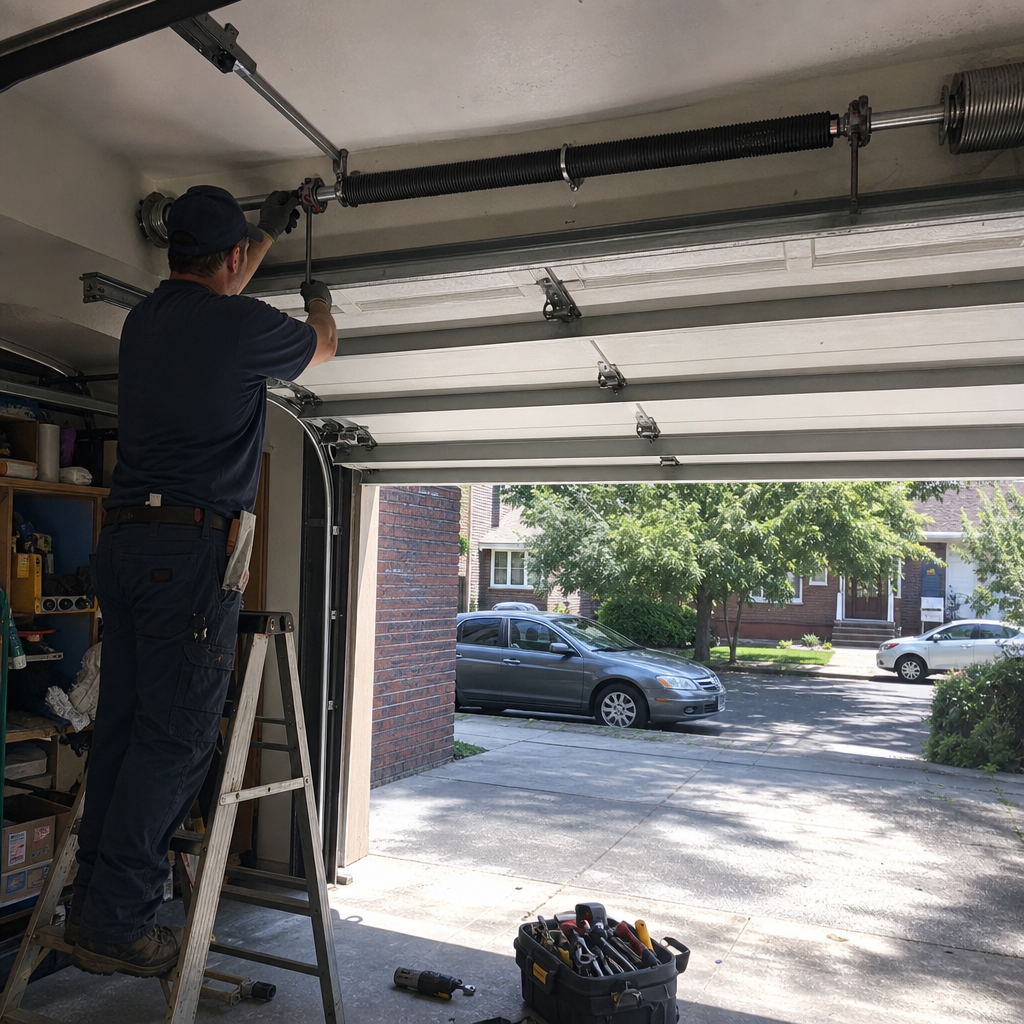
Some garage door issues are genuinely dangerous and should never be DIY projects. Torsion springs store massive mechanical energy—a failed spring or incorrect winding can cause serious injury or death. Cables under tension can whip unpredictably. If you notice a broken spring, a door that falls rapidly, or cables that have come off the drum, stay clear and call a professional.
Other scenarios that warrant expert evaluation: doors that reverse unexpectedly (safety sensor or force-setting issues), openers that strain or stall (potential door balance problem), and any installation in a building with co-op or DOB complications. Coastal Garage Door Repair New York offers free estimates in New York City—call (833) 758-1244. When Mark Thompson arrives, you’ll get a direct assessment from the owner and lead technician, not a sales pitch from a commissioned estimator.
Frequently Asked Questions
Most garage door repairs in New York City range from $180 for roller or cable replacement to $450 for torsion spring replacement, with custom hardware or constrained-access installations adding 15-30%. Co-op buildings with restricted service hours sometimes incur additional coordination fees. Call (833) 758-1244 for an exact quote—estimates are free.
Same-day service is often available for common repairs like spring replacement, cable repair, and opener troubleshooting, though co-op buildings with restricted access hours may limit scheduling. Emergency garage door service is offered for urgent, time-sensitive failures. Call (833) 758-1244 to check current availability.
Yes, nearly all co-op buildings in New York City require board approval for exterior door replacements, and many regulate aesthetic details like color, panel style, and window configuration. The approval process typically takes 4-12 weeks. Start this process before ordering any materials.
Cold weather thickens lubricants, stiffens weatherstrip, and can cause battery backup systems to underperform. In below-grade New York City garages, temperature differentials between the cold concrete floor and warmer air above create condensation that affects electrical components. Annual professional adjustment of opener force and limit settings prevents most cold-weather problems.
Repair is usually more economical for isolated component failures in doors under 15 years old. Replacement becomes cost-effective when multiple systems fail simultaneously, when the door lacks modern safety features, or when custom fabrication would be required anyway due to non-standard dimensions. We’ll give you honest numbers for both options.
Wall-mounted jackshaft openers like the LiftMaster 8500W series are the best solution for ceilings under 8 feet of available headroom. They mount beside the door rather than overhead, preserve ceiling space for storage or ductwork, and operate more quietly than trolley-style units—important in buildings with living spaces above the garage.
The Bottom Line
Garage doors in New York City operate under constraints that demand specialized expertise: pre-war building stock with non-standard dimensions, co-op boards with aesthetic authority, DOB permits for structural changes, and security considerations that suburban guides never address. The right contractor for this market combines factory-trained brand knowledge with documented NYC experience—someone who’s solved the specific problems your building presents before.
At Coastal Garage Door Repair New York, garage doors are all we do. Mark Thompson brings 8 years of focused expertise and personal accountability to every job, backed by 845 verified reviews from homeowners who’ve experienced the difference that specialist knowledge makes. Whether you need repair, replacement, or a professional assessment of what your building actually requires, we’re ready to help.
Call (833) 758-1244 for a free estimate. When the owner shows up, the expert shows up.
Written by Mark Thompson, Owner & Lead Technician at Coastal Garage Door Repair New York, serving New York City since 2018.