
Last updated July 10, 2026
Garage Door Repair Maintenance Checklist for New York City Homeowners
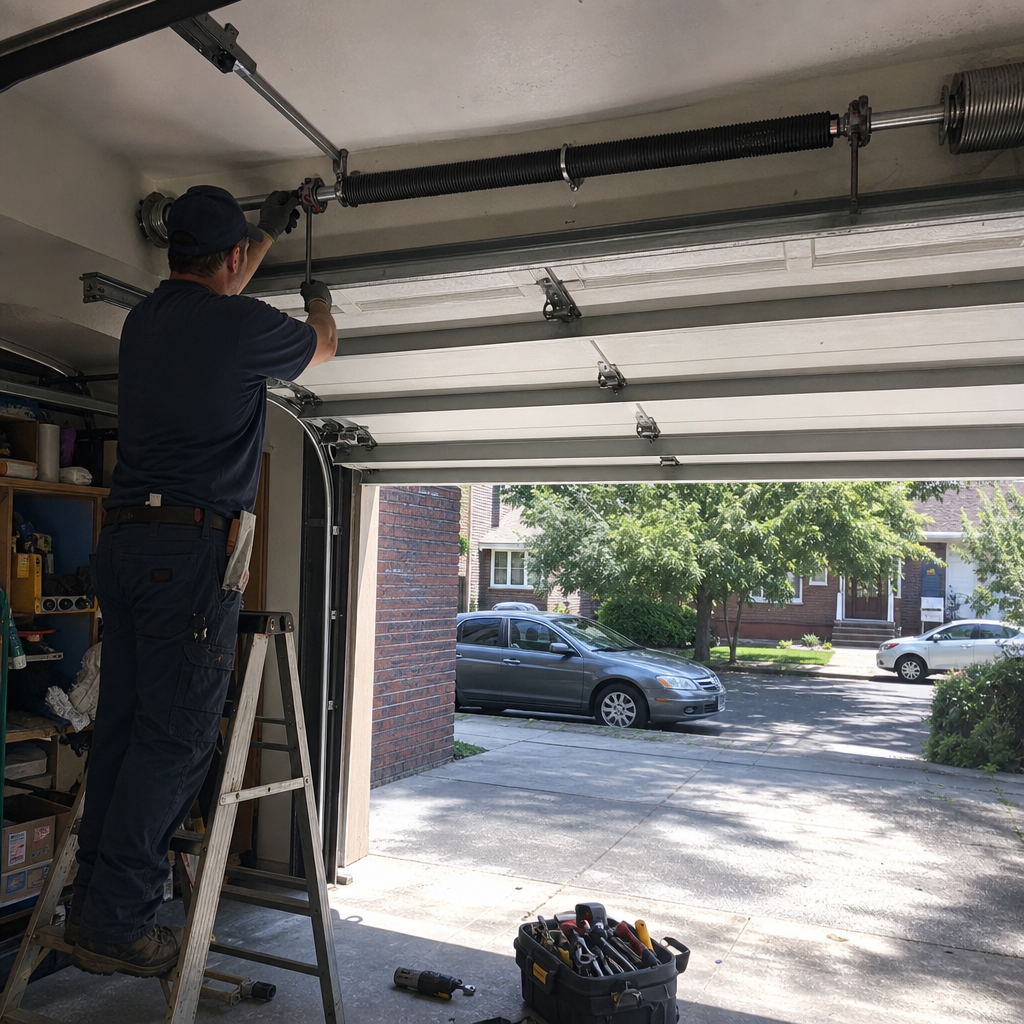
The number one cause of premature spring failure we see in Gramercy Park and Kips Bay garages isn’t age — it’s salt-accelerated corrosion from East River air that most owners don’t spot until the spring snaps at 6 a.m. on a Tuesday. After eight years servicing New York City homes and reading patterns across 845 customer reviews, we’ve learned that standard maintenance advice fails here because it ignores three forces: harbor salt, subway vibration, and the corrosive soup of idling vehicles in enclosed urban structures. This guide gives you a checklist calibrated for those realities, plus what to document before you call anyone so you’re never at an information disadvantage.
Quick Answer
New York City homeowners should inspect their garage door system quarterly, lubricate moving parts every four months with silicone-based lubricant (not WD-40), and check for salt corrosion monthly if they live within a mile of the Hudson or East River waterfront. Replace weatherstripping before winter and test safety reverse features every 30 days. Annual professional inspection is recommended for torsion spring systems due to high-tension hazards.
Table of Contents
- Salt Corrosion Inspection: The NYC Waterfront Factor
- Vibration Damage from Subway and Street Traffic
- Urban Grime and Weatherstripping Failure
- Lubrication Schedule for NYC Humidity Swings
- Safety System Testing: What the City Requires
- What to Document Before Calling a Repair Company
- Seasonal Maintenance Calendar
Salt Corrosion Inspection: The NYC Waterfront Factor
If your garage sits within a mile of the Hudson River, East River, or New York Harbor, salt air is actively eating your hardware. We’ve replaced torsion springs in Battery Park buildings that were five years old but looked fifteen — pitted, orange-streaked, and brittle from chloride exposure. The corrosion isn’t cosmetic; it weakens the steel’s crystalline structure until the spring can’t handle its rated cycle count.
What to inspect monthly:
- Torsion springs: Look for orange or white powdery deposits, pitting, or flaking metal. Run a gloved finger along the coil; roughness means corrosion is advancing. In waterfront neighborhoods like Red Hook or Long Island City, we see this progress 40% faster than inland.
- Cable drums and end bearings: These sit at the spring’s anchor points and collect salt spray that drips down from the shaft. Check for rust bloom where the cable wraps around the drum.
- Track mounting brackets: The brackets securing your vertical tracks to the jambs are often galvanized steel — better than plain steel, but not immune. Look for white corrosion products at bolt holes.
- Hinge pins: Especially on lower panels where road salt tracked in by tires splashes upward. Chamberlain and LiftMaster systems we service in Astoria often show hinge seizure before opener strain alerts the owner.
What to do: Wipe visible corrosion with a dry cloth, then apply a thin film of white lithium grease as a barrier. Do NOT attempt to remove or adjust torsion springs — the stored energy can cause severe injury or death. When corrosion reaches the spring itself, replacement by a trained technician is the only safe option. Garage Door Repair in Gramercy Park and throughout the city, we carry salt-rated hardware for waterfront installations.
Vibration Damage from Subway and Street Traffic
New York City‘s subway system doesn’t just rattle your coffee cups — it loosens garage door hardware over time. Buildings near the Lexington Avenue Line, Queens Boulevard Line, or any elevated track experience continuous low-frequency vibration that competitors’ generic checklists never address. We’ve found track bolts finger-loose in Sunnyside garages and opener mounting brackets that had backed out half an inch from years of tremor.
Quarterly vibration check — 10 minutes:
- Close the door and disconnect the opener (pull the red release cord). Manually lift the door halfway and let go — it should stay balanced, not drift up or slam down.
- Inspect the lag screws securing the opener’s header bracket to the wall above the door. These take the most vibration transfer. Tighten with a socket wrench; if they spin freely, the wood fiber is stripped and needs longer lags or wall anchors.
- Check track bolts at every bracket — vertical tracks have 3-4 brackets per side, horizontal tracks 2-3. Use a 7/16″ wrench. In our experience, the bottom bracket bolts loosen first because they also bear the door’s full weight during opening.
- Shake the opener unit gently by hand. Any movement at the ceiling mount means the angle iron or strut has worked loose. This is critical — a falling opener is a 30-pound projectile.
- Listen during operation: New rattles or metallic buzzing often mean a fastener has backed out and a component is resonating against track or frame.
We’ve seen Craftsman chain-drive openers in Harlem shake their own chain tension bolts loose after three years of 1/2/3 train vibration. A $0.50 bolt, unchecked, becomes a $400 opener replacement. Mark Thompson checks these points personally on every service call — when the owner shows up, the expert shows up.
Urban Grime and Weatherstripping Failure
New York City garages collect more bottom-seal contamination than suburban equivalents for three reasons: denser traffic kicking up particulates, construction dust that settles for blocks, and the organic slurry of decomposing leaves in street gutters that gets tracked in on tires. This grime acts as an abrasive against rubber and vinyl seals, and it harbors moisture that accelerates rot.
The inspection:
- Bottom seal (U-shaped astragal): Close the door and look at the gap from outside. Light visible means the seal is compressed or torn. In Chelsea and Flatiron, where construction is constant, we see seals packed with concrete grit that grinds through in 18 months.
- Side and top weatherstripping: Vinyl or rubber bulb seals should rebound when compressed. Cracking, permanent flattening, or detachment from the jamb means replacement. Check especially where the seal meets the door’s path — any drag marks indicate misalignment wearing the seal unevenly.
- Threshold condition: The aluminum or rubber strip on the floor takes the most abuse. If it’s cracked or lifted at edges, water and vermin enter. In flood-prone Red Hook or Gowanus, this is your first defense.
Cleaning protocol: Monthly, wipe the bottom seal with a damp rag to remove grit buildup. Quarterly, apply a vinyl/rubber protectant (not petroleum-based — that degrades rubber). Replace seals proactively: in NYC’s environment, 2-3 years is typical lifespan, not the 5+ years suburban guides suggest. Garage Door Installation in Gramercy Park and nearby neighborhoods includes upgraded brush seals for high-grime environments.
Lubrication Schedule for NYC Humidity Swings
Generic advice says “lubricate once a year.” In New York City, that’s inadequate. Our humidity swings from 35% in January to 80%+ in July, and that moisture cycle causes metal expansion, contraction, and condensation in ways that strip lubricant faster than stable climates.
Our NYC-calibrated schedule:
| Component | Frequency | Product | What to Avoid |
|---|---|---|---|
| Hinge pins and rollers | Every 4 months | Silicone spray or white lithium grease | WD-40 (dries, attracts dust) |
| Torsion spring | Every 4 months | Light film of lithium grease | Heavy buildup (traps grit) |
| Chain or screw drive | Every 6 months | Manufacturer-specified lubricant | Generic motor oil |
| Track interior | Never lubricate | N/A | Any lubricant (causes roller slip) |
| Weatherstripping | Every 3 months | Silicone-based rubber protectant | Petroleum-based products |
Critical detail for NYC: After summer’s humidity peak, inspect for white corrosion on lubricated surfaces — the grease can emulsify with condensed moisture and lose its protective quality. In Gramercy Park basements and underground garages, we’ve seen this emulsification destroy bearings in under two years. Wipe old lubricant with a clean rag before reapplying; don’t just add layers.
For Raynor and LiftMaster belt-drive openers, the belt itself needs no lubrication, but the trolley and rail guide benefit from the same 4-month schedule. Your Raynor specialist at Coastal can confirm the specific points for your model during a service visit.
Safety System Testing: What the City Requires
While New York City doesn’t have a garage door-specific inspection mandate, building codes incorporate ANSI standards for automatic door operators, and liability falls on the homeowner if a malfunction injures someone. We’ve testified in insurance disputes where a failed safety reverse was the difference between coverage and denial.
Monthly safety tests — two minutes:
- Photo-eye test: Start the door closing, then pass a broom handle through the beam (the two sensors face each other 4-6 inches above the floor). The door must reverse immediately. If it hesitates or continues, the eyes are misaligned, dirty, or failing. In NYC garages, we see photo-eyes knocked out of alignment by storage items, bicycles, or contractors’ equipment constantly.
- Force-sensitivity test: With the door closing, apply upward pressure on the bottom edge with your hand (stand clear of the center to avoid pinch points). The door should reverse within 2 seconds. If it doesn’t, the opener’s force setting is too high — a hazard for children and pets. Chamberlain and LiftMaster openers have adjustable dials; consult your manual or call us rather than guessing.
- Door balance test: Disconnect the opener and lift manually. A properly balanced door stays at any position between fully open and closed. If it drifts, the spring tension is wrong — and that’s a professional repair, not a DIY adjustment.
Important safety note: Torsion springs and extension springs are under extreme tension. Never attempt to adjust, wind, or release spring tension. The force stored in a standard residential torsion spring can cause severe laceration, broken bones, or death. This is not hyperbole — we’ve seen the aftermath of well-intentioned DIY attempts. Garage Door Opener in Gramercy Park and all NYC neighborhoods, we handle spring work with proper winding bars and safety protocols.
What to Document Before Calling a Repair Company
When your garage door fails, you’re stressed and vulnerable to upselling. Documentation puts you back in control. After 845 service calls, we know the information gap that lets bad actors inflate quotes — and the details that let honest technicians diagnose accurately.
Before you call, photograph and note:
- The door’s behavior, not your interpretation: “Makes grinding noise at 2 feet from floor” is more useful than “I think the motor is broken.” Note exactly when in the cycle the problem occurs.
- Brand and model numbers: On the opener, this is usually a sticker on the motor housing or light cover. For the door itself, check for a sticker on the interior face of the top section or end stiles. Clopay, Amarr, and Wayne Dalton all place these differently.
- Age of components: Check your home inspection report, closing documents, or any previous service receipts. A 15-year-old opener has different economics than a 3-year-old one.
- Recent changes: New construction nearby? Seismic activity from blasting? Neighbor’s renovation vibration? These contextual clues explain failures that seem spontaneous.
- Previous repairs: What was done, when, and by whom. Repeat failures at the same component suggest misdiagnosis the first time.
When you call Coastal Garage Door Repair New York at (833) 758-1244, this documentation lets Mark Thompson arrive with the right parts — often completing the repair in a single visit rather than a diagnostic trip plus a return. 845 homeowners have trusted us precisely because we respect prepared customers and don’t exploit information asymmetry.
Seasonal Maintenance Calendar
Spring (March–May):
- Post-winter corrosion inspection — salt residue from snow-melting compounds accelerates rust
- Test door balance after temperature swings may have affected spring tension
- Clean photo-eyes; winter storage often leaves them coated or bumped
- Inspect bottom seal for rodent damage — breeding season begins
Summer (June–August):
- Lubricate all moving parts before humidity peaks emulsify existing protection
- Check opener motor ventilation — NYC garages often overheat, shortening electronics life
- Inspect weatherstripping for UV cracking in any sun-exposed garage
- Test force sensitivity; heat expansion can affect opener calibration
Fall (September–November):
- Replace weatherstripping proactively before heating season
- Clear track of fallen leaves — compressed leaves become acidic slurry
- Tighten all hardware after summer’s expansion/contraction cycles
- Schedule professional inspection if system is 5+ years old
Winter (December–February):
- Increase corrosion inspection frequency to biweekly if using road salt
- Verify emergency release cord function — frozen doors may need manual operation
- Check for ice damming at threshold that prevents full seal
- Monitor opener strain; cold-thickened grease increases motor load
Common Mistakes to Avoid
- Using WD-40 as a lubricant: It’s a solvent and water displacer, not a lubricant. It evaporates and leaves a sticky residue that collects NYC’s airborne grit into grinding paste. We’ve replaced rollers destroyed by this “helpful” habit.
- Ignoring subway-adjacent vibration: Homeowners near the 7 train or F train elevated lines who skip quarterly hardware checks often discover the problem when a track bolt falls out and the door jams catastrophically.
- DIY spring adjustment: YouTube tutorials make this look manageable. The torsion spring on a standard 16×7 steel door stores roughly 10,000 foot-pounds of torque. The specialized winding bars and training required aren’t optional — they’re survival.
- Replacing only the broken spring: On dual-spring systems (most doors over 8 feet wide), springs are matched pairs. Installing one new spring with one fatigued spring creates imbalance that destroys the opener’s gears within months.
- Neglecting the emergency release: In a power outage or opener failure, you need to lift manually. If the release mechanism is corroded or the door is unbalanced, you’re trapped — a genuine safety issue in fire-prone buildings.
- Calling a general handyman for opener diagnosis: Garage door openers have specific error codes, force profiles, and safety interlocks. A generalist without factory training on Genie, LiftMaster, or Craftsman systems often replaces the wrong component, doubling your cost.
When to Call a Professional
Call a dedicated garage door specialist — not a general handyman — when you encounter: broken or frayed cables; any visible gap in a torsion spring; a door that won’t stay open or closed; opener motor humming without movement; bent or dented tracks; or repeated photo-eye failures after cleaning and alignment. These scenarios involve high-tension components, precise balancing, or electrical diagnosis that requires trade-specific training and tools.
Coastal Garage Door Repair New York offers free estimates in New York City — call (833) 758-1244. When Mark Thompson arrives, you’re getting the decision-maker, not a subcontractor learning on your door. Garage doors are all we do, and we’ve done 845 of them with the accountability that comes from owner-led service.
Frequently Asked Questions
Quarterly inspections and lubrication every four months are the minimum for NYC’s salt air, humidity swings, and vibration environment — roughly twice the frequency generic guides recommend for stable climates. Monthly checks are warranted if you live within a mile of the waterfront or near elevated subway lines. Call (833) 758-1244 to schedule a professional inspection if you’re unsure where your building falls on that spectrum — estimates are free.
Repair is typically cost-effective for openers under 10 years old with isolated failures like stripped gears or failed circuit boards; replacement makes more sense when the unit is 12+ years old, has repeated failures, or lacks modern safety features like rolling-code security and force-limiting electronics. In New York City, where electrical supply can be inconsistent, newer openers with soft-start motors also reduce strain on building wiring. We can evaluate your specific Chamberlain, LiftMaster, or other brand unit and give you an honest assessment — call (833) 758-1244.
Same-day service is often available for common failures like broken springs, cable detachment, and opener malfunctions, particularly in Manhattan and Brooklyn core neighborhoods where we maintain inventory for the eight major brands we service. Emergency garage door service is offered for situations where the door is stuck open (security risk) or stuck closed (vehicle trapped). Call (833) 758-1244 to check current availability — fast response when it matters most.
Cold thickens lubricant and contracts metal components, increasing friction and creating gaps where hardware was snug; in NYC’s older buildings, the temperature differential between a heated garage interior and freezing exterior can also cause track misalignment as the building settles slightly. The solution is seasonal-appropriate lubrication and a pre-winter hardware inspection — not turning up the opener force, which compromises safety. We handle winter prep inspections throughout the city.
Visible orange rust, white powdery deposits, or a rough texture when you run a gloved finger along the coil are clear indicators; in advanced cases, you’ll see flaking metal or a “dust” of corrosion particles on the floor beneath the spring. If you spot any of these signs, the spring’s cycle life is compromised and failure is likely imminent — schedule replacement before it snaps, potentially damaging the door or injuring someone nearby. Spring replacement is never a DIY project due to extreme stored tension.
Verify whether the problem is mechanical (door won’t move smoothly) or electrical (opener won’t respond) by disconnecting the opener and attempting manual operation — this single test prevents misdiagnosis and ensures the technician arrives with appropriate parts. Also note the brand, model, approximate age, and any recent changes to the garage environment. Documentation saves time and protects you from unnecessary upselling. Call (833) 758-1244 with what you’ve observed; we’ll confirm whether you need a service call or can resolve it yourself.
The Bottom Line
New York City garage doors face a unique trio of stressors — salt corrosion, mechanical vibration, and urban contamination — that standard maintenance advice ignores. The homeowners who avoid premature failures are those who inspect quarterly, lubricate for humidity rather than calendar convenience, and treat torsion spring systems with the respect their stored energy demands. Document your system details before problems arise, know when professional intervention is the safe choice, and choose a specialist whose entire business is built around this single complex system. Coastal Garage Door Repair New York home — where Mark Thompson’s eight years of dedicated expertise and 845 verified reviews mean you’re getting an owner who shows up, not a franchise dispatching anonymous labor.
Written by Mark Thompson, Owner & Lead Technician at Coastal Garage Door Repair New York, serving New York City since 2018.