
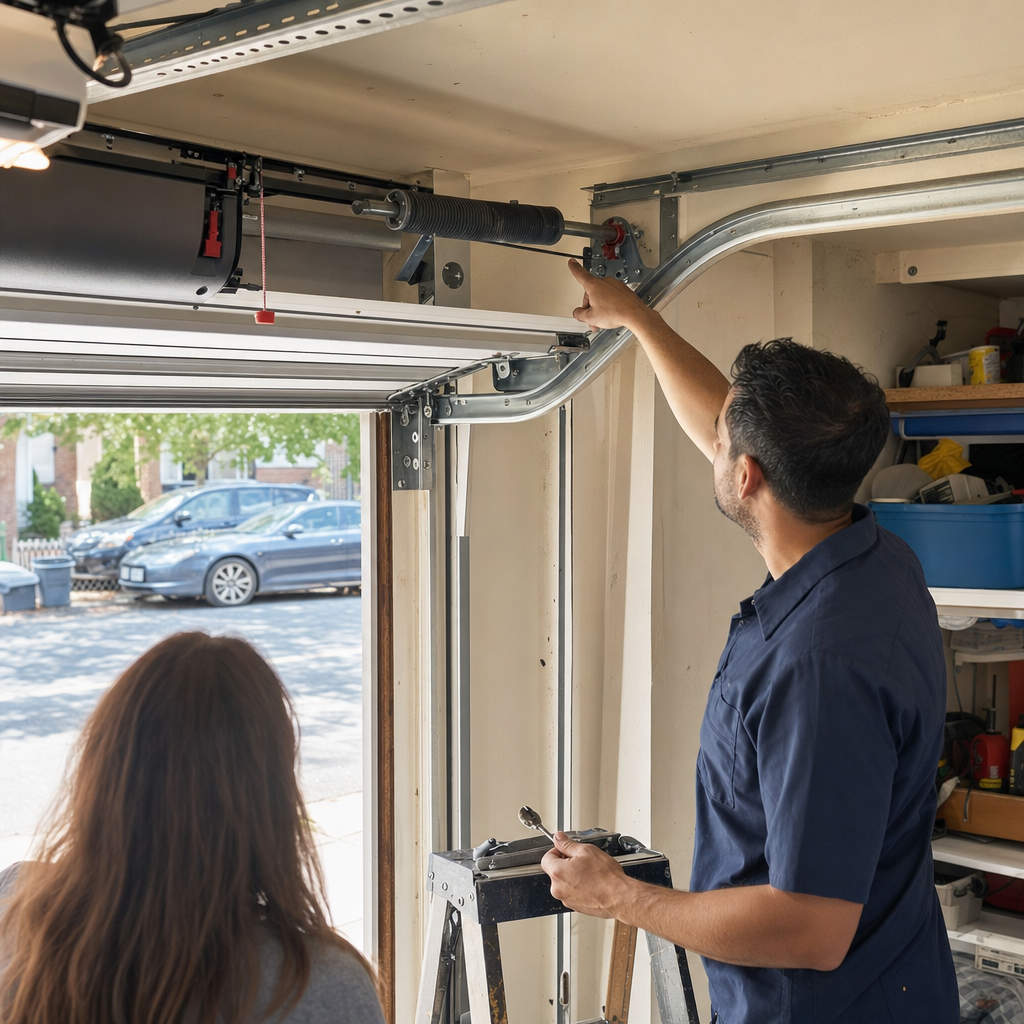
Why Does My Garage Door Reverse Before Closing in New York?
Your garage door reverses before hitting the floor because its safety system detects an obstruction that either is there or appears to be there — most commonly misaligned photoelectric sensors, a limit switch set too short, or mechanical resistance triggering the opener’s force sensor. In New York’s older housing stock with unheated garages and decades of settling frames, the cause is usually mechanical rather than electronic. If you’re stuck now, call us at (833) 758-1244 and we’ll walk you through a two-minute test to tell which problem you’ve got.
What Your Door Is Actually Trying to Tell You
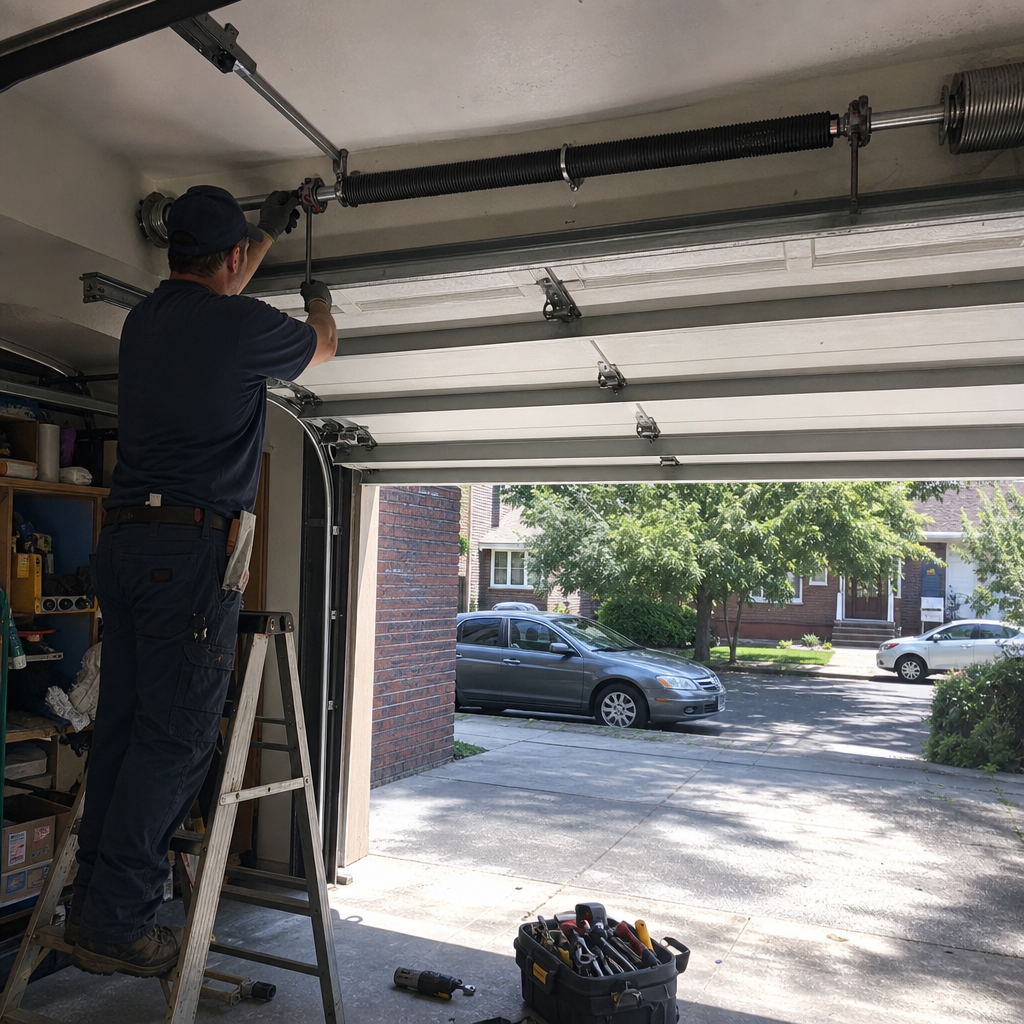
Here’s the thing most homeowners in Astoria, Flatbush, or Washington Heights miss: your garage door isn’t broken. It’s doing exactly what it was designed to do — reversing to protect something. The question is what it thinks it needs to protect against, and there are four different answers. Start with the wrong one and you’ll waste a Saturday adjusting sensors when the real problem is a binding roller that’s about to snap a cable.
Mark Thompson, Owner & Lead Technician at Coastal Garage Door Repair New York, sees this diagnostic mistake constantly. “Homeowner calls saying their opener’s shot, they’ve reset it twice, swapped the remote battery — and the whole time it’s a $12 roller that’s seizing in the track.” After eight years running this business and 845 jobs logged, we’ve developed a specific testing order that saves both of us time.
The Four Causes, in Diagnostic Order
Test these in sequence. Skip a step and you risk adjusting the wrong component, which can mask a bigger problem or damage the opener.
1. Photoelectric Sensor Misalignment or Obstruction
Those two small boxes facing each other near the floor — usually with tiny LED lights — are your first check. If one light is blinking or off entirely, the sensors have lost alignment or something’s blocking the beam.
In New York, this gets tricky fast. Road dust from the BQE or West Side Highway coats sensor lenses in outer-borough garages, especially in Red Hook, Long Island City, and anywhere with heavy truck traffic. More specifically: in January, condensation on those lenses freezes overnight in unheated garages from Woodside to Bay Ridge. The ice creates a blurry sensor signal that reads as a false obstruction. Door reverses at 7 a.m., works fine by 10 a.m. when the garage warms up. We’ve taken calls for “opener replacement” where the fix was a lens wipe and a weatherstrip check.
What to check: Clean both lenses with a dry cloth. Verify both LEDs are solid (not blinking). Make sure nothing’s leaning against the door in the beam path — garbage cans, bikes, that folding chair you keep meaning to fix.
2. Limit Switch Set Too Low
The opener’s limit switch tells it how far to travel before the door is “closed.” If it’s set short — common after DIY installations or when a new opener gets slapped onto an old door — the motor thinks it hit an obstacle before the door actually reaches the floor. It reverses, exactly as programmed.
This shows up constantly in pre-war buildings throughout Manhattan and the Bronx where original wood-frame garage openings have settled unevenly over 80+ years. The door physically reaches the ground, but the opener’s internal counter says it should have traveled another inch, so it assumes something’s trapped underneath.
What to check: Watch the door as it closes. Does it reverse the instant the bottom edge touches the floor, or before? Touch-down reversal means limit switch. Mid-air reversal means sensor or mechanical issue.
3. Mechanical Resistance Triggering the Force Sensor
This is the one that separates a $0 DIY fix from a $175–$710 repair call. Every modern opener has a force sensor that measures how hard the motor works. If resistance spikes — worn rollers, binding hinges, cable tension imbalance, a dented track — the opener assumes it hit a kid’s bike or a pet and reverses hard.
Here’s the test Mark learned back in the Building Maintenance Technology program at Queensborough Community College and still uses on every job: disconnect the opener (pull the red release cord), lift the door manually halfway, and let go. If it drifts down fast, your springs are fatigued. If it sticks or grinds anywhere in the travel, you’ve got a mechanical binding issue. If it stays put and moves smoothly, your problem is electronic — sensor or limit switch.
Critical safety note: If you feel grinding, catch points, or the door feels heavier on one side, do not continue operating it. A door with uneven cable tension or a failing spring can drop without warning. The high-tension components in these systems can cause serious injury. This is when you call a trained professional — not a general handyman, but someone who offers Emergency Garage Door Repair in New York, NY.
In our experience across New York’s five boroughs, mechanical resistance is the most common actual cause of mystery reversals, especially in buildings from the 1950s–1980s where original hardware has cycled through 30,000+ openings. Roller bearings dry out. Hinge pins elongate their holes. Tracks accumulate a decade of grit that no amount of WD-40 fixes properly.
4. Dirty or Damaged Sensor Lens (The NYC-Specific Variant)
We broke this out separately because it’s distinct from misalignment — and because New York’s environment makes it disproportionately common. Road salt aerosol in winter, construction dust in summer, and pollen bursts from the city’s tree canopy in spring all etch and cloud sensor lenses over time. A physically aligned sensor pair with cloudy lenses behaves exactly like a misaligned pair: intermittent reversals, works sometimes, fails at random.
We’ve replaced sensors in Park Slope brownstones where the original lenses were so crazed from salt exposure that the infrared beam scattered like a flashlight through fog. The homeowner had lived with “moody” door behavior for two years.
How the Fix Differs by Opener Brand
Here’s where factory-trained familiarity matters. If you’ve diagnosed a limit switch or force-sensor issue and want to adjust it yourself, the procedure varies significantly:
- LiftMaster and Chamberlain: Force adjustment is a pair of screws on the opener housing — typically labeled “up force” and “down force.” Quarter-turn increments only. These are the most common openers in New York condos and co-ops installed since 2015.
- Genie: Uses a sensitivity dial rather than discrete screws, usually marked with a range rather than specific values. Easier to over-adjust if you’re not watching the door during testing.
Mark’s trained on all eight major brands — LiftMaster, Chamberlain, Genie, Clopay, Amarr, Wayne Dalton, Craftsman, and Raynor — and the adjustment points vary enough that guessing based on a generic YouTube video often makes things worse. “If I wouldn’t put it on my own garage, I’m not recommending it to you.” When in doubt, call someone who knows your specific hardware.
When to Handle It Yourself vs. Call a Pro
We’re not going to alarm you into a service call you don’t need. Here’s the honest breakdown:
| Problem | DIY? | Typical Cost if We Handle It |
|---|---|---|
| Sensor misalignment | Yes — 10 minutes, no tools | $140–$285 (service call minimum) |
| Dirty sensor lenses | Yes — dry cloth, possibly replacement lenses | $140–$285 |
| Limit switch adjustment | Yes — screwdriver, careful testing | $140–$380 (opener repair range) |
| Grinding/manual resistance | No — safety risk | $175–$710 (garage door repair range) |
| Uneven door weight in manual test | No — spring/cable issue | $155–$400 (cable or spring repair) |
The line is simple: if the door moves smoothly and evenly by hand, it’s an electronic adjustment. If it doesn’t, it’s mechanical — and mechanical problems on 150+ pound doors with high-tension springs are not where you learn DIY.
What This Costs in New York
New York’s market runs higher than national averages for two reasons: parking for service vehicles, and the physical challenge of hauling equipment into basement garages or up to rooftop parking structures in Manhattan. Our pricing reflects actual job conditions we’ve encountered from Inwood to Sheepshead Bay.
For reversal-specific issues, you’re typically looking at:
- Sensor realignment or replacement: $140–$285
- Opener limit/force adjustment or repair: $140–$380
- Roller, hinge, or track repair (mechanical binding): $130–$285
- Spring or cable repair if manual test reveals imbalance: $155–$400
Full Garage Door Repair service calls that require multiple components or diagnostic time run $175–$710. We don’t quote over the phone for mechanical issues because “grinding” can mean anything from a $130 roller swap to a $590 panel replacement if the binding has damaged the door sections. What we do promise: no upsell. If your door needs a $12 roller, that’s what we recommend.
Why New York Garages See This More Often
Three local factors drive our higher-than-average call volume for reversal issues:
Thermal cycling: Unheated garages in Queens and Brooklyn see 60+ degree temperature swings between January cold snaps and summer heat. Metal tracks expand and contract. Lubricants thin in August, gum in February. Rollers that tracked smoothly in September start binding by January.
Settled structures: Pre-war and post-war buildings throughout the city have header beams that have sagged fractionally over decades. That sag throws off track plumb by degrees you can’t see but the opener’s force sensor registers instantly.
Deferred maintenance culture: New Yorkers fix what breaks, not what wears. A door that gets 4–6 cycles daily (both adults commuting, kids with activities) accumulates 1,500+ cycles annually. Original rollers rated for 10,000 cycles are dust by year seven. Most homeowners notice only when the reversal behavior starts.
FAQs
The most common cause is misaligned or dirty photoelectric sensors — the door “sees” an obstruction that isn’t there because the infrared beam is interrupted by dust, ice, or physical misalignment. In New York’s winter, condensation freezing on sensor lenses overnight creates exactly this false signal. Start by cleaning both lenses with a dry cloth and checking that both sensor LEDs glow steady; if that doesn’t fix it, the issue is likely a limit switch set too short or mechanical resistance triggering the force sensor. Call (833) 758-1244 if you’re unsure — we’ll talk you through the 60-second diagnostic.
You can safely handle sensor cleaning, sensor realignment, and limit switch adjustments yourself if the door moves smoothly when disconnected from the opener. If the door grinds, sticks, or feels heavy on one side during manual lifting, stop — that’s a Garage Door Off Track Repair in New York, NY situation that requires professional repair due to injury risk from high-tension components. We’ve been called to too many jobs where a homeowner made a mechanical problem worse by adjusting the opener’s force setting to “override” the resistance. That damages the motor and doesn’t fix the underlying binding.
Most reversal fixes in New York run $140–$380 for electronic adjustments or sensor work, or $175–$710 if mechanical components like rollers, hinges, or tracks need repair. Spring or cable issues, detected when the manual lift test shows uneven weight, typically cost $155–$400. We provide exact quotes after inspection — estimates are free, and we’ll tell you honestly if it’s a 10-minute DIY fix you can handle without us. Call (833) 758-1244 to schedule.
Condensation on sensor lenses freezes overnight in unheated garages, scattering the infrared beam so the opener reads a false obstruction; the problem disappears mid-morning as the garage warms. Alternatively, grease on rollers and tracks thickens in cold weather, increasing mechanical resistance that triggers the force sensor. We’ve seen this pattern repeatedly in outer-borough neighborhoods with detached garages — Woodside, Astoria, Flatbush — where morning reversals mysteriously “fix themselves” by lunch. A quick sensor cleaning and lubricant swap to cold-rated formula usually solves it permanently.
When You’re Ready to Stop Guessing
Eight years of running Coastal Garage Door Repair New York has taught us that most reversal problems are straightforward once you test in the right order. The hard part is knowing which test to run first — and having the experience to recognize what the results actually mean. 845 homeowners have trusted us with that diagnostic, and Mark Thompson still handles every job personally because when the owner shows up, the expert shows up.
If you’d rather have it looked at, Coastal Garage Door Repair New York offers Best Garage Door Repair in New York, NY with a no-pressure assessment — call (833) 758-1244.
Written by Mark Thompson, Owner & Lead Technician at Coastal Garage Door Repair New York, serving New York, NY.