
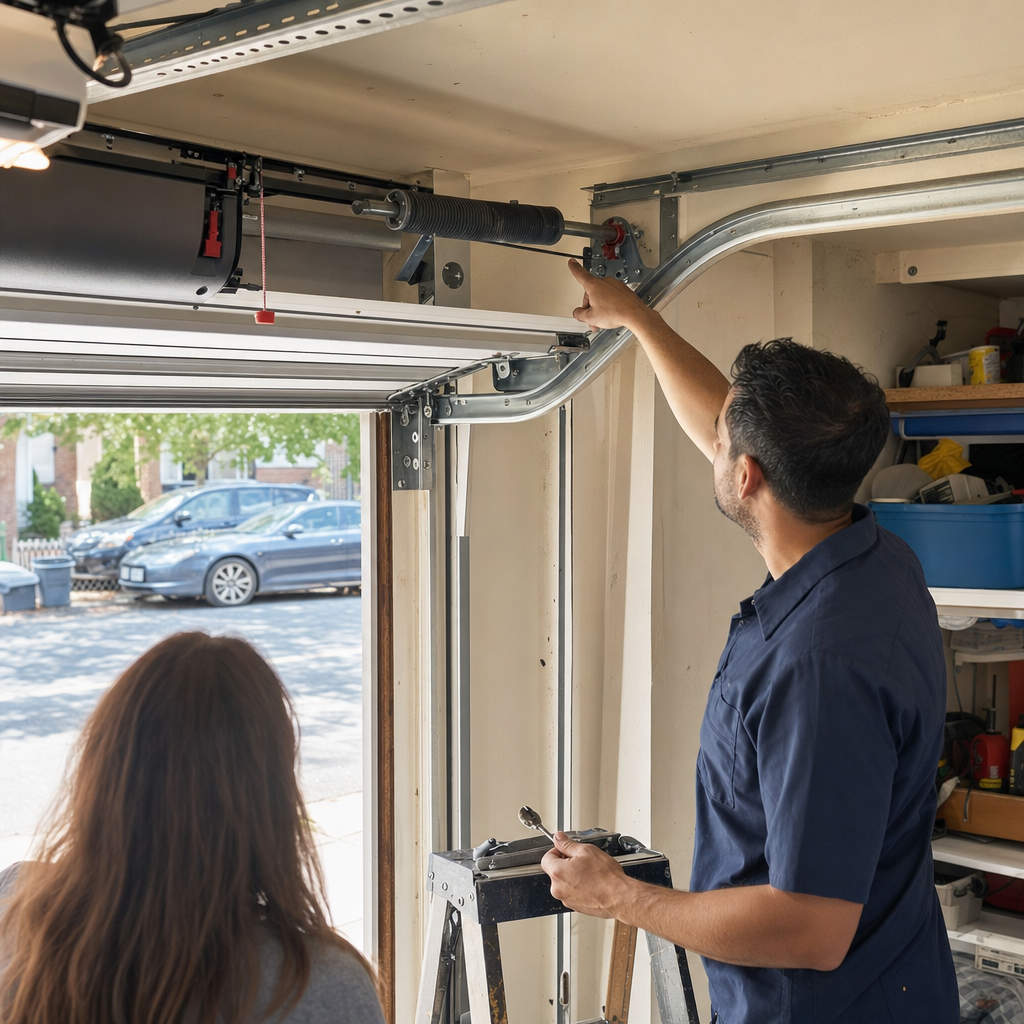
Garage Door Won’t Close in New York? Start With the Light Blinks
Most garage doors that won’t close in New York are telling you exactly what’s wrong—you just need to know how to read the signal. Press your wall button or remote and watch the overhead light on the opener motor: if it flashes a specific number of times, that’s a diagnostic code, not a random glitch. For the majority of LiftMaster and Chamberlain units installed across Queens and Brooklyn over the last decade, that blink pattern is the fastest path to knowing whether you’re looking at a 30-second fix or something that needs a pro on-site. If you’re stuck now and it’s after hours, call us at (833) 758-1244—we’ll walk you through the blink check over the phone before dispatching.
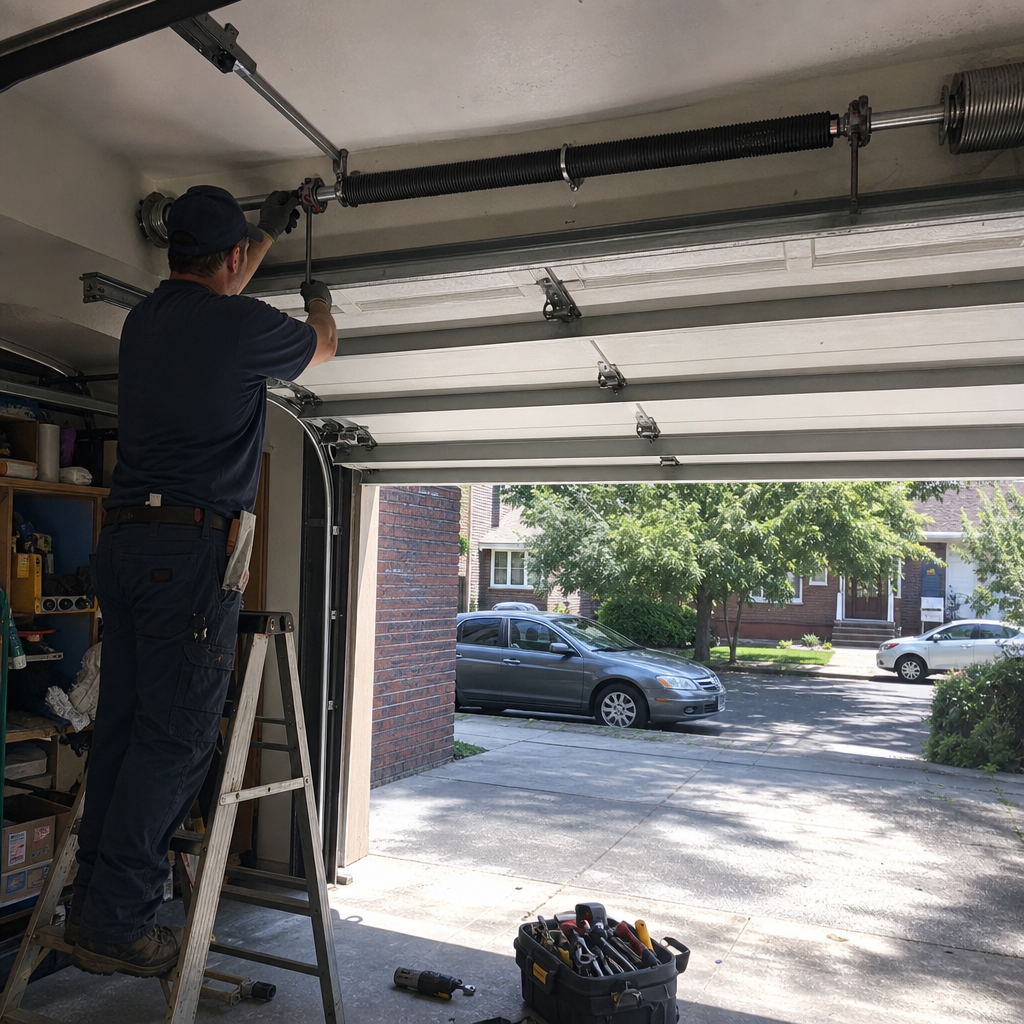
Why New York Garages Fail Differently Than Suburban Systems
Manhattan brownstones, Astoria brick row houses, and Fresh Meadows split-levels all share one thing: garage doors that work harder than their suburban counterparts. In New York, we’re dealing with tighter clearances, older electrical runs, and freeze-thaw cycles that chew through weatherstripping faster than almost anywhere else Mark’s worked.
That Queensborough Community College training in structural systems comes in handy here. A door that won’t close in Woodside—where Mark grew up about a mile from the 7 train—often traces back to the same thing: the concrete slab heaved slightly in February, the bottom seal froze overnight, and now the opener thinks it’s hitting an obstruction. We’ve seen this exact pattern in Sunnyside, Jackson Heights, and right down through Bay Ridge. The opener isn’t broken. The safety system is doing its job too well.
Here’s what separates a New York garage door failure from the generic troubleshooting videos:
- Freeze-bonded seals: Rubber bottom weatherstripping can freeze to concrete when overnight temps drop below 25°F—common January through March in New York. The opener tries to close, hits resistance, and reverses.
- Shared electrical in older buildings: Pre-war wiring and overloaded circuits in attached garages mean power issues masquerade as opener failures more often than in standalone suburban homes.
- Street-level exposure: A door stuck open on a ground-floor Brooklyn or Manhattan garage isn’t just a repair call—it’s a security exposure that changes whether this is a morning fix or a right-now emergency.
The 90-Second Diagnostic: What Happens When You Press the Button
Forget component names for a second. What actually happens when you hit the button? That’s the whole diagnostic, and almost no generic page organizes it this way. We’ve structured this around the six observable behaviors that cover roughly 90% of the “won’t close” calls we run in New York.
Nothing Happens at All—No Sound, No Light
This is usually power, not the opener. Check the outlet the motor’s plugged into with a phone charger or lamp. If it’s dead, you’ve got a tripped breaker or a GFCI that popped—common in New York garages where moisture from snow-melt gets into outdoor-rated outlets. If the outlet’s live and the motor still won’t hum, the logic board may have taken a surge. We carry replacement boards for LiftMaster and Chamberlain units on the truck, and most installs run $140–$380 for opener repair depending on parts.
The Door Moves a Few Inches, Then Reverses
Classic safety sensor issue. The infrared beam across the door opening—usually 4–6 inches off the ground—got bumped, knocked by a garbage can, or coated with road salt spray. In New York, we see this constantly after plowing season: that fine mist of brine from the BQE or Cross Bronx coats the lens, and the beam can’t see through it.
Quick test: wipe both sensor lenses with a dry cloth, make sure both LED lights are solid (not blinking), and check that nothing’s dangling in the beam path. If both LEDs glow steady and the door still reverses, the sensors may be misaligned or failing—similar to the issue covered in Why Does my Garage Door Reverse? (New York, NY). We realign or replace sensor pairs for $140–$285 as part of track and safety system service.
The Door Moves Partially, Then Stops—No Reversal
This is mechanical binding, not electrical. Something’s physically fighting the door. In New York’s tighter garages, we see storage boxes shifted against the track, broom handles fallen into the roller path, or—more seriously—a cable that’s come off the drum and is snagging the panel edge. Do not force the door by hand if you suspect a cable issue. Garage door cables are under extreme tension and can cause serious injury if they release unexpectedly. This is a call-a-pro situation, and cable repair typically runs $155–$295.
Remote Works, Wall Button Doesn’t (or Vice Versa)
Narrows it down fast. If the wall button works but the remote doesn’t, you’ve got a receiver or remote battery issue—sometimes just reprogramming after a power flicker. If the remote works but the wall button doesn’t, the low-voltage wiring between button and motor has a break, often where it gets pinched against the door frame in older New York installations with metal conduit.
The Overhead Light Flashes a Specific Number of Times
This is the one detail that solves more “won’t close” mysteries than anything else we teach homeowners. Most LiftMaster and Chamberlain openers manufactured since 2015 flash the main light in a repeating count to indicate the fault:
| Blink Count | What It Means | Typical Fix & Cost |
|---|---|---|
| 1 blink | Safety sensor wire disconnected or shorted | Wiring repair: $140–$285 |
| 2 blinks | Safety sensor misaligned or obstructed | Alignment or replacement: $140–$285 |
| 4 blinks | Safety sensor temporarily blocked (clear obstruction) | Usually no charge—user fixable |
| 5 blinks | Motor overheated or RPM sensor failure | Opener repair: $140–$380 |
| 6 blinks | Motor circuit failure | Opener repair or replacement: $295–$650 |
| 10 blinks | Door control or wiring short | Low-voltage wiring repair: $140–$285 |
Check your owner’s manual—it’s printed on a sticker inside the light lens cover on most units. If you can’t find it, text us a photo of the motor model number and we’ll tell you the code meaning before we even schedule.
The Door Closes Fine Manually But Not With the Opener
This usually points to force settings or travel limits that drifted out of calibration. New York’s temperature swings—70°F Tuesday, 20°F Friday—cause metal components to expand and contract enough that a door that closed fine in October starts binding by January. The opener’s force sensor thinks it’s hitting resistance and reverses. We adjust force and limit settings as part of standard Garage Door Repair service, typically $175–$710 depending on what else we find during the full system check.
The Frozen Seal Fix Every New Yorker Should Know
Here’s a 30-second test that saves us hundreds of emergency calls every winter. If your door won’t close on a cold morning and the opener reverses after moving an inch or two:
- Pull the red emergency release cord (usually a T-handle hanging from the opener rail) to disengage the motor.
- Try lifting the door manually by the handle. If it feels glued to the floor at the bottom, the rubber seal has frozen to the concrete.
- Don’t yank. Pour warm (not boiling) water along the threshold, or use a hair dryer on low heat to melt the bond.
- Once free, raise and lower the door manually a few times to break any remaining ice.
- Re-engage the opener by pulling the release cord toward the motor unit until it clicks back onto the trolley.
Safety note: If you need to leave the door open while working on it, or if you’re waiting for repair with the door stuck open on a street-level garage, disengage the opener and manually lock the door in the closed position using the slide bolt or lock handle. An open garage in a dense New York neighborhood is a security exposure—don’t leave it unattended.
When to Call Tonight vs. When It Can Wait Until Morning
Not every “won’t close” situation needs an emergency fee. Here’s how Mark sorts them on the phone:
Can wait: Sensor misalignment in a garage with no street access, a detached structure, or a secure interior courtyard. The door’s secure where it is, and the fix is straightforward daylight work.
Call now: Door stuck open on any ground-floor or street-facing garage in Manhattan, Brooklyn, or the Bronx. Door off-track with a vehicle trapped inside and you need it for work tomorrow. Cable visibly frayed or off the drum—this can cascade into panel damage or injury if the door moves unexpectedly. Opener smoking or smelling electrical—fire risk in attached garages with shared walls.
We offer Emergency Garage Door Repair in New York, NY for exactly these high-stress, time-sensitive failures. When the owner shows up, the expert shows up—Mark handles every emergency call personally, not a subcontractor who’s reading a script.
What Repair Actually Costs in New York
We don’t quote blind over the phone, but here’s what 845 homeowners have paid for the most common “won’t close” fixes across our New York service area:
| Repair Type | Typical Range | Most Common Cause |
|---|---|---|
| Sensor alignment / replacement | $140–$285 | Physical knock or salt coating |
| Opener repair (board, gear, limit) | $140–$380 | Power surge, wear, or calibration drift |
| Cable repair | $155–$295 | Fraying, off drum, or corrosion |
| Spring repair | $210–$400 | Fatigue failure (common after 8–12 years) |
| Track realignment | $140–$285 | Impact damage or hardware loosening |
| Full opener replacement | $295–$650 | Obsolete unit or motor failure |
Every repair starts with a free on-site assessment. If I wouldn’t put it on my own garage, I’m not recommending it to you. We’ve built an 845-review, 4.8-star average by being straight about what’s actually broken and what isn’t.
FAQs
Most repairs that fix a door that won’t close run between $175–$710 in New York, with sensor issues and limit adjustments at the lower end and opener replacement or spring work at the higher end. We don’t charge a diagnostic fee if you proceed with the repair. Call (833) 758-1244 for a free estimate—Mark will give you a straight range before coming out.
It’s almost always the bottom rubber seal freezing to the concrete threshold, or metal components contracting enough to increase friction beyond the opener’s force setting. Pour warm water along the threshold to test—if the door frees up and operates, you’ve found it. For a permanent fix, we can upgrade to a vinyl or thermoplastic seal that resists freeze-bonding better than standard rubber.
Repair is usually cheaper if the unit is under 10 years old and the failure is a board, gear, or sensor issue—typically $140–$380 versus $295–$650 for a new opener installation. But if the motor itself is failing, the unit is obsolete with no parts availability, or you’ve already repaired it twice, replacement saves money long-term. We’ll tell you straight which path makes sense for your specific unit.
Yes—same-day service is standard for most repairs, and emergency response is available for street-level or security-exposed situations. Mark carries inventory for all 8 major brands we service: LiftMaster, Chamberlain, Genie, Clopay, Amarr, Wayne Dalton, Craftsman, and Raynor. Call (833) 758-1244 and we’ll slot you in based on urgency.
Get It Diagnosed Right—Not Guessed At
Garage doors are all we do. Eight years of focused trade experience, 845 verified reviews, and Mark Thompson showing up personally on every call means you get the decision-maker, not a dispatcher sending whoever’s available. If your garage door won’t close and the blink-code check hasn’t solved it, we’ll figure out what’s actually wrong and fix it once.
If you’d rather have it looked at, Coastal Garage Door Repair New York offers a no-pressure assessment in New York—call (833) 758-1244.
Written by Mark Thompson, Owner & Lead Technician at Coastal Garage Door Repair New York, serving New York, NY.